Monday, May 1, 2017

"We Had Hoped..."

This reflection was written for the Devotions From Home series of St. Paul's Episcopal Church, Mt. Lebanon, Pennsylvania.  It is intended to be a synopsis of the Sunday sermon sent to those who can not make it to church regularly.  Audio of sermons and other material can be found at www.stpaulspgh.org.

Easter 3 - April 30th

“We Had Hoped…,” said the two disciples as they ran out of Jerusalem on the way the Emmaus.  Maybe some of the saddest words in Luke’s gospel, or all of scripture.  It is in the past tenses.  The hope is gone. Lost.  With the events in Jerusalem the days before seemed so dark, all hope had ended.  

In a way, I think we all have been on that road to Emmaus at one time or another.  When “We Had Hoped…” When the cancer came back, the job never materialized, the degree seemed wasted, the friend never got better, the child was never born, the marriage ended.  When “we had hoped…”
And that is right where Jesus met them.  He met the disciples when they were: sad, distraught and angry. And they didn’t even know it.  Until, they all broke bread together.  And their eyes were opened, to see that God in Jesus was right there with them all along.

We break bread as followers of Jesus so that we can see the presence of God in our lives and world.  We break this bread together so that we can have, in the words of the Reverend John Thomas, “Food for the Journey.” Food for the journey of life that can help us see God’s hands at work in our lives and the life of the world.  So that we can know hope.  Hope that we can share with the world.
Last week in a TED Talk Pope Francis said:

“To Christians, the future does have a name, and its name is Hope. Feeling hopeful does not mean to be optimistically naïve and ignore the tragedy humanity is facing. Hope is the virtue of a heart that doesn't lock itself into darkness, that doesn't dwell on the past, does not simply get by in the present, but is able to see a tomorrow. Hope is the door that opens onto the future. Hope is a humble, hidden seed of life that, with time, will develop into a large tree. It is like some invisible yeast that allows the whole dough to grow, that brings flavor to all aspects of life. And it can do so much, because a tiny flicker of light that feeds on hope is enough to shatter the shield of darkness. A single individual is enough for hope to exist, and that individual can be you. And then there will be another "you," and another "you," and it turns into an "us." And so, does hope begin when we have an "us?" No. Hope began with one "you." When there is an "us," there begins a revolution. “ 

A revolution a love, kindness and compassion.  Which is what our hurting world needs more than ever right now.

Monday, April 17, 2017

Resurrection Eyes

This reflection was written for the Devotions From Home series of St. Paul's Episcopal Church, Mt. Lebanon, Pennsylvania.  It is intended to be a synopsis of the Sunday sermon sent to those who can not make it to church regularly.  Audio of sermons and other material can be found at www.stpaulspgh.org.

Easter Sunday - April 16

We live in a world that sends us messages, that teaches us stories – stories that limit our vision. Stories about violence being a solution, stories about how success is measured through what we have, what we own, stories about thin being better, busyness being a sign of value or strength, and that protecting what is ours, should happen at any cost, and death always wins.  Stories that can shape our reality, shape our vision. Limit our reality, limit our vision.

We all can so easily become stuck, whatever the reason.  Become stuck in a vision that is shallow, or enclosed.  A vision where we cannot see that there will ever be a way out, another way to go, an alternate way to live.  A vision where death has won, and life seems to have lost. 

That’s where Hope comes in.  That’s where we need resurrection eyes to see.  Eyes that see new life coming out of death, renewal out of destruction, hope in despair. Easter prods and provokes us with an immense stretching exercise. God has renewed a life given to the evil of this world on behalf of those with no other helper. That earth-shattering and tomb-shattering rebirth has planted the seeds of hope in each one of us. Yet those seeds do not produce fruit without struggle.  We learn, we practice, we develop those resurrection eyes.

Seeing the world through the eyes of God, through the eyes of resurrection is hard work.  A few years ago, our former Presiding Bishop, Katherine Jefferts Schori says ”We are not born with the ability to insist on resurrection everywhere we turn. It takes the discipline and repetition that forms an athlete – in this case, a spiritually fit Christian. We practice our faith because we must – it withers and atrophies unless it's stretched. We must continue to give evidence of the faith that is within us.”  And this is not something you can do alone.  The shared hope of a community is essential.

The Christian community is meant to be a “mutual hope society,” with each one offering courage to another whose hope has waned, insisting that even in the darkest of night, new life is being prepared. A community showing us that there is no experience, there is no evil, no loss, no dark place – that God cannot bring new life out of.  That work of learning Hope is constant – it will not end until the end of all things.


Together we can shout, "Alleluia, he is risen! Indeed, he is risen, Alleluia!" even when some among us are not quite so confident as others.  Even when some struggle, as others rejoice.  The entire community is rising and risen when even a small part of it can rejoice and insist that God is renewing the face of the earth, and their own lives,  and light has dawned upon us.

Monday, April 10, 2017

What procession will we follow?

This reflection was written for the Devotions From Home series of St. Paul's Episcopal Church, Mt. Lebanon, Pennsylvania.  It is intended to be a synopsis of the Sunday sermon sent to those who can not make it to church regularly.  Audio of sermons and other material can be found at www.stpaulspgh.org.

April 9 - Palm Sunday

The population of Jerusalem swelled during the days surrounding the Passover.  Some scholars say the city grew from 20,000 to 150,000 people during those days.  You can probably imagine the streets crowded with pilgrims, merchants, tourists and residents.  Since the Passover was a festival remembering the Hebrew people’s liberation from another oppressive ruler, the Roman governor always got a little anxious around this time of year.  Due to all of this, the Roman Governor, Pontius Pilate, increased the size of the garrison in Jerusalem.  So the day before the Passover each year a column of Roman military would process from the West into Jerusalem, with their swords and chariots and the beating of drums. This procession was meant to strike fear in the hearts of those who saw it – a statement of Rome’s power and might!

On this first Palm Sunday, there was another procession.  This time from the East, down the Mount of Olives.  It was led by a different kind of king, riding on a donkey. Crowds of peasants from the countryside joined him, and they laid branches of palms on the road as he walked.  It was a procession of peace, of justice and humility. Some scholars say this procession was an intentional counter-protest to the procession entering from the West that day.  A sign of peace, in the face of military might.

The story of Jesus’ passion is a story of the conflict between these two processions, and all that they represent. 


The question for us this Holy Week, and each day, is what procession will we follow?     

Saturday, January 21, 2017

Join in the Conversation this New Year!

This article ran in the January 19, 2017 edition of the Medford Transcript. (A6)

Join in the Conversation this New Year!
The Reverend Noah H. Evans, Rector, Grace Episcopal Church

Between Christmas and New Years I had some time off from work. During this special week, I was able to unplug from the internet, email and social media. With this sudden openness in my daily life and work tied to electronic jungle of our 21st century culture - I found space and time to rediscover the special old time work of conversation. Spending time joining in conversation with family, friends, and some people I had not seen in years reminded me about the depth of experience and perspective of others that unfolds in conversation.  How conversation opens me to see the entire person - not just their positions, or sound bites, or social media statuses.  Conversation leads to connection, and I have come to believe, real connection with others changes us.  This time in conversation brought me back to why I am involved in the Medford Conversation Project - a project to help convene diverse conversation all across our city.

Medford Conversations is a coalition of more than 20 community groups, whose mission is to include and actively engage a multiplicity of voices in our community. Through conversations, the project hopes to encourage people to create and act on visions for a sustainable, just, and thriving Medford.

I have served at Grace Episcopal Church in Medford for almost nine years, and in just that time I have seen the City change tremendously. Looking back at Medford over the last 25 years, the transformation of the city's demographics is even more  profound.  As a result of this significant community change, in my experience, social networks in our city are underdeveloped, especially across geography, ethnic and generational differences.  And sometime we see that civic involvement is low.  Often times people don't know their neighbors, or the perspectives of people who live in other parts of the city. Connections between people across religious, ethnic and socio- economic difference are weak.  The extraordinary diversity of Medford is a real gift and asset, and we have an extraordinary opportunity right now for a rich social fabric as we find ways to connect across our difference. I see Medford Conversations as a way to connect and learn from one another and strengthen the civic and cultural life of our City. As a result of our conversations, I am hoping to see a strengthening of our civic society and civic involvement.  I also  hope to see all of us have a greater understanding of the joys and challenges of living and working together in a diverse community, and be willing to "lean in" to what we need to do to have a just and equitable community.

This winter Medford Conversions is holding its first conversation series.  Building on the past work of supporting single-time conversation events (Arts Summit (’15), MLK Day (’16) Envision Medford (’16), and World Café at Medford High (’16)) Medford Conversations seeks to bring together groups of 10  or so meeting in several sessions with a trained facilitator over a several month period.  It is our hope that engaging in this type of ongoing in-depth conversation will help to build relationships and understanding in our community that can lead to action for the betterment of all.

Our winter Conversation series "Who Belongs? Dialogues about Race and Ethnicity in Medford and Beyond" begins with an opening event on Sunday, January 29, 2017, 2-4:30PM at Medford High School.  Everyone is invited to this event, whether they are able to participate in ongoing conversations or not. Over the following six weeks dozens of people in small groups will meet around the city to further their discussion. We conclude with a citywide event on March 12 with an action forum to ‘walk the talk’ to make Medford an even greater place to live. Come join the effort, what better way to kick off the New Year.  For more information, and to register, visit http://medfordconversations.org/.


Wednesday, November 9, 2016

Standing with Standing Rock

 Standing with Standing Rock

A version of this blog post appeared in the Medford Transcript on 11/10/16

It was night, on November 2nd, when we first pulled over the hill and could see the Oceti Sakowin camp. The sky was black, filled with stars. The river flats below were dotted with campfires, and I could see the shadows of tents, trailers and tepees below. Smoke from the campfires filled the air, and I recognized the pungent smell of burning sage. I could hear the sound of Native American singing, and many different drum circles echoing in the cold North Dakota air. Over 2000 people were staying in the camp that night. The camp was established last spring as an act of opposition to the Dakota Access pipeline, bringing together dozens of Native American tribes and environmental activists from across the country. The residents refer to themselves as “Water Protectors,” guarding the water of the Missouri River, the lifeblood of the Standing Rock Lakota tribe. And then I looked up and saw it on the hill past the camp: the white stadium lights blaring down on the construction site. President Obama had asked that construction be voluntarily suspended, but the work continued as the pipeline inched towards the Missouri River.

Standing Rock is a place I feel deep connection to. I have been to there several times. A friend and mentor of mine served as the Episcopal priest on the South Dakota side of the reservation for a number of years. I had a classmate who was from Standing Rock. During seminary, he died suddenly, and dozens of people from the reservation traveled to New York for the funeral, and we hosted many, including the ceremonial drum in our one bedroom apartment for several days.

Last week, the Reverend John Floberg, the Episcopal priest serving on the North Dakota side of the Standing Rock reservation, issued a call to clergy across the country to join with him for an action against the proposed Dakota pipeline which crosses sacred Lakota lands, and threatens the water of the Standing Rock reservation. He had hoped for 100, and more than 500 came. I was joined by over 25 clergy from Massachusetts, with 15 from the Episcopal Diocese of Massachusetts. The action was prayerful, peaceful, nonviolent.

The Dakota Access pipeline is a 1,170 mile, $3.7 billion pipeline that is slated to cross 4 states to bring North Dakota oil into Illinois for distribution around the world. The pipeline is planned to go under the Missouri River, less than a mile a mile north of the current Standing Rock reservation land, crossing land that is said to be Lakota land by their 1851 treaty with the United States Government. The Standing Rock tribe fear that the pipeline will pollute their drinking water, and its route crosses land that is sacred to their tribe. Original plans showed the pipeline crossing the river north of Bismarck, but it was moved south when the people of the town feared it would pollute their water. The current route is a textbook example of environmental racism, moving environmental risk from whites to vulnerable minorities. This pipeline is just the newest expression of generations of violence against native people. Environmental groups have also joined this movement in order to prevent the pipeline to be built at all, to help keep carbon resources that contribute to climate change in the ground.


On the morning of the action, we gathered at Standing Rock and representatives from different Christian denominations read statements of repudiation of the “Doctrine of Discovery,” the church and legal doctrine that white Christian colonists used to usurp lands from indigenous peoples. From there we marched to the now-blockaded bridge over Cannon Ball River that separates the Oceti Sakowin camp from the pipeline site. This bridge also connects the Standing Rock reservation with hospitals and services in Bismarck, and its closure has led to a 40 mile detour for all emergency vehicles. On one side of the bridge we sang, prayed and offered testimonials. On the other side armored police vehicles, police with automatic weapons and more than 20 police vans kept watch. In recent days police response to protesters have been marked by violence and militarized police tactics, including use of tear gas and pepper spray and use of rubber bullets. The day after the clergy demonstration, two rows of razor wire and concrete barricades were added as well. The Presiding Bishop of the Episcopal Church, Michael Curry, had referred to Standing Rock as “our new Selma.” Standing on that bridge, I knew that to be true.

In contrast to the militarized bridge, Oceti Sakowin camp is a place of extraordinary hospitality, healing and peace. People at the camp refer to everyone as “relatives.” Everyone at the camp is fed and given shelter. Donations of food, clothing, tents and supplies are constantly being delivered from across the country. An elder over a loudspeaker calls out when someone needs a ride or other help, to connect them to those who can provide assistance. There are workshops for healing from trauma and addiction. People from different Native American tribes are finding connection, healing, purpose and cultural revival through the life of the camp. It is a stark contrast to the violence being done on the hill above, violence against the earth and against native peoples.


The Obama administration has said it will now look into rerouting the pipeline. There is some hope there for a positive outcome, but public pressure and support of the Water Protectors in the Oceti Sakowin camp must continue as well. And even if the pipeline is moved, native communities will still need our witness and solidarity in the future. I have found that there are moments in a life of faith, and life as a citizen, where we have to stand with a larger community in solidarity with people who are being marginalized, and this is one of those moments.

Thursday, November 3, 2016

Gathering of Friends: first day at Standing Rock


Last night we gathered in the gym in Canon Ball, North Dakota with almost 500 religious leaders from many denominations and faiths, to eat and learn a little more about the events we are to participate in over the next days.

The Rev. John Floberg, Episcopal Priest on Standing Rock, told us how he had prayed for 100 people to come and is overwhelmed by the outpouring of support.  A local historian told us the history of the sacred lands the proposed Dakota pipeline is to cross, including centuries of the life of villages and life on the land.

We also heard about how today we would first join in a witness to our denouncing of the Doctrine of Discovery, which is the 16th century church doctrine which has been used to colonize the Americas, marginalize native peoples, and has been golden into American cultural perspectives, which has led to this pipeline to being built here.

We will then gather in a sacred circle of prayer on the site of the camp that was violently cleared last week, in an expression of solidarity for the native people of the region, and standing against the pipeline's construction.

Many familiar faces from across the church were there, and many new friends and relationships being born.  It is good for us to be here.

Tuesday, November 1, 2016

Traveling to Stand in Solidarity with Standing Rock

Memorial to Chief Gall who invited
the Episcopal Church onto
Standing Rock
Last week, the Reverend John Floberg, the Episcopal priest serving on the North Dakota side of the Standing Rock reservation, issued a call to clergy across the country to join with him for an action against the proposed Dakota pipeline which crosses sacred Lakota lands, and threatens the water of the Standing Rock reservation.  This week, I will be traveling with over a dozen individuals, both lay and ordained, from the Episcopal Diocese of Massachusetts to join in this action.

St. Elizabeth's, Wakpala, SD
on Standing Rock
Standing Rock is a place I feel deep connection to.  I have been to the Standing Rock reservation several times.  My friend and mentor, the Rev. Robert Schwarz, served as the Episcopal priest on the South Dakota side of the reservation for a number of years.  Sara and my kids visited him and his wife Jean there, we had a chance to meet the people who lived there, and visited their churches.  Also, in seminary Sara and I had a classmate, Hal Clark, who was from Standing Rock. During our first year, he died suddenly, and dozens of people from the reservation traveled to New York for the funeral, and we hosted many, including the ceremonial drum in our one bedroom apartment for several days.

After the news last week of the escalating actions by officials against the Standing Rock Water Protectors, I was kept awake at night about how to respond from so far away. Hearing of peaceful protesters teargassed, shot with rubber bullets and violently arrested was deeply disturbing. I am aware of both of the environmental and human rights issues at play here - and also feel that this happening to people and a place I feel so connected to there must be a way to participate in taking action.  A colleague reached out to me and said she was interested in going, and Sara and I offered to fund her trip.  I asked my Bishop, Alan Gates, if he would also pay for someone to go if I could recruit them.  He said he would send two people.  It snowballed from there, and my Vestry said they would pay for me to go - so now a large delegation will be traveling from Boston to meet up with almost 400 others in Standing Rock.

Please keep us in prayer this week, and I will update this blog as the journey unfolds. Here is the sermon I preached on Sunday about deciding to go on this trip:


Monday, September 26, 2016

A Celebration of Rainbows, Medford’s Diversity, and the Perfection of God’s Creation

A Celebration of Rainbows, Medford’s Diversity, and the Perfection of God’s Creation
The following is an open letter from members of the Medford Interfaith Clergy Association in response to a Letter to the Editor from Pastor Thomas Michael, printed in the Transcript, Thursday, September 15, 2016.  This letter appeared in the September 22 Medford Transcript. 

Dear Mayor Burke and Medford Friends,

We are grateful for the affirmation of Medford’s LGBTQIA citizens represented by the rainbow banner hanging at City Hall. That positive act of support and pride was celebrated by all of us and many members of our congregations. In fact, we hope there will be an even larger rainbow banner next year! Thank you for this witness to our city’s commitment to justice and equality for all.

As seminary trained and denominationally ordained leaders of both Christian and Jewish faith communities in Medford we are compelled to offer an alternative perspective to that represented by Pastor Thomas Michael in his September 15 Letter to the Editor. While his letter presumes to speak for all “all sincere Bible believing Christians” and all “God-fearing taxpayers in Medford” we can assure you that it does not.

We are faith leaders who believe that all of God’s creation is made in God’s image. We affirm the wholeness of LBGTQIA persons and support the caring and loving relationships in which they may be engaged.

We are religious practitioners who are guided by scripture. We each do this in different ways through our varied traditions.  We each, though, have come to a similar conclusion of our support of the full inclusion of LBGTQIA persons in our faith communities and civic life.

Scripture tells us to “love kindness, seek justice and walk humbly with God.” (Micah 6:8). As such, we have learned not to attempt to speak for other representatives of our faith traditions. Together, we reject hate, work for justice and do our best to lead with love.

We pray, during this time of political division and tension in our community over difference and change, that our Medford neighbors know that we are here amongst you, praying and working unceasingly for the welfare of our city and the well-being of all of her people. We are here, loving God and loving you, our neighbors, all of our neighbors. May it be so for all and with all. May God bless you and keep you.

Rev. Dr. Maggie Arnold, Assistant Rector, Grace Episcopal Church
Rev. Gerald Bell, Pastor, Shiloh Baptist Church
Rev. Brenda Bennett, Pastor, Community Baptist Church
Rabbi Braham David, Rabbi, Temple Shalom
Rev. Dr. Dorothy Emerson, Unitarian Universalist
Rev. Noah Evans, Rector, Grace Episcopal Church
Rev. Tony-Jarek Glidden, Pastor, Community Methodist Church
Rev. Thomas Hathaway, Pastor, North Prospect Union Ujnited Church of Christ
Rev. David Kilpatrick, Pastor, West Medford Baptist Church
Rev. Wendy Miller Olapade, Lead Pastor, Sanctuary United Church of Christ
Rev. Lambert Rahming, Community Minister, Sanctuary United Church of Christ
Rev. Matthew Rasure, Pastor, First Baptist Church
Rabbi Talya Weisbard Shalem, Medford Resident and Rabbi

Thursday, March 3, 2016

Green Burial in Medford

The movement to allow "Green Burials" at Oak Grove Cemetery is moving forward.  This is an important effort to provide this option in our city for both cultural and environmental reason.  Read more about this movement here!


Local Press on Green Burials:
Medford City Council, local clergy want plan for green burials
Medford resident requests space for natural burial at Oak Grove
GREEN BURIALS: Movement for natural burial gathers steam across U.S., Massachusetts
Members of the Medford Interfaith Clergy sent the following letter to the Trustees of Oak Grove Cemetery:

Medford Interfaith Clergy
c/o the Reverend Noah H. Evans
Grace Episcopal Church
160 High Street Medford, MA 02155

February 15, 2016

James McDevitt, Chair, Oak Grove Cemetery Board of Trustees
Stacie Clayton, Vice Chair, Oak Grove Cemetery Board of Trustees
Susan Dee, Oak Grove Cemetery Board of Trustees

Dear Members of Oak Grove Cemetery Board of Trustees:

We write to you today as the faith leaders of the City of Medford, the people who are often given the privilege and responsibility at presiding at the funeral and burials of many people in Oak Grove cemetery. Oak Grove is a beautiful cemetery and truly an important part of the spiritual and religious fabric of our City. We are aware that for a number of reason the practice of “green burial” has been brought to your attention. We are writing you today in encouragement and support of the Board of Trustees of Oak Grove Cemetery developing practices and policies which will allow this to happen at Oak Grove.

Though we understand that green burial is not the right choice for all people, we believe that the practice of green burial values the importance of care for the earth that is present in many of our individual religious traditions and would be a faithful choice for members of our community. As you know, green burial does not put toxins into the earth as embalming does; nor release toxins into the atmosphere as cremation does, rather, green burial allows for the body to decompose naturally, unlike the embalmed body placed inside a vault or liner. Therefore, green burial promotes the preservation of unpolluted land and conservation land as well. Green burial allows for the person's last wish to be a gift to the earth, because it does not pollute the land or atmosphere. We believe that green burial is a respectful way to handle the dead.

We understand that this is a traditional practice for burial, though it is only recently being reclaimed in the United States. We hope that your deliberations about the best ways to accommodate green burial at Oak Grove can move forward swiftly and in a timely fashion.

Please know that we are all available to continue to support your efforts.

Thank you.
Peace,

Rev. Tess Baumberger, Unitarian Universalist Church of Medford
Rev. Brenda Bennett, Community Baptist Church, Medford
Rev. Wendy Miller Olapade, Sanctuary UCC, Medford
Rev. Tony Jarek-Glidden, Community Methodist Church, Medford
Rev. Gerald Bell, Shiloh Baptist Church, Medford
Rev. Matthew Rasure, Frist Baptist Church, Medford
Rev. Noah H. Evans, Grace Episcopal Church, Medford

Cc: Stephen Brogan, Superintendent, Oak Grove Cemetery
Stephanie M. Burke, Mayor of Medford
Mark Rumley, Medford City Solicitor
Medford City Council

Friday, January 29, 2016

Thursday, October 1, 2015

Why I Give

I wrote this reflection for the October 2015 Grace Church Newsletter

In the Episcopal Church, members of the congregation are asked each year to make a pledge of what they plan to give to the Church for the entire coming year. At Grace Church we do this in late October to early November, with special events and mailings during this time. For some people, especially for those new to the Episcopal Church, making a pledge may be a new experience.

Why do I make a pledge each year?

First, in pledging I am supporting the parish community to which I belong, and its mission. Grace Church is a self-supporting parish; we as a community have to support our shared work. By making a pledge, I am giving the Vestry and parish leadership the ability to plan for the ministry of the parish in the coming year. By making a financial pledge, I am also saying that I support and want to be part of the mission of the parish. Each year that I have been at Grace Church, I have more and more deeply come to believe that what we do together is the work of God.  Part of God’s work to care, to serve and to welcome all at God’s table.  That’s something I want to be a part of.  So I give.

Second, pledging is a spiritual discipline. Giving is a discipline that people of faith have practiced for millennia. Spiritual disciplines are acts that we choose to do not because we always feel like it or want to, but because they are part of our commitment to God, to each other, and to ourselves. Pledging helps us to know that all that we have, things material and spiritual, is a gift from God. By giving generously, we thank God for God's loving care for our lives, and we dedicate what we have been given to God’s purposes. Giving is a practice of thanksgiving that over time makes us even more grateful for the abundance of God’s grace in our lives. It opens our hearts to the awareness that all life is a wondrous gift. Over the last few years, my wife Sara and I have come to learn how we can build our own family budget around our giving. It has taken time to get there, adjusting our budget each year, but now we tithe.  We give 10% of our income away.  We give about 1/3 of that tithe to Grace Church through our Annual and Capital Campaign pledged.  We give about 1/3 to my wife’s church, Christ Church in Waltham, through Annual and Capital Campaign pledges and about 1/3 to other causes and needs that are important to us.  Giving is an important part of our lives, and something we try to teach and demonstrate to our children as well.  This discipline helps to remind us on a daily basis that all that we have and do is truly a gift from God.  Our giving helps us to know more deeply to grace God has given us all. 

My prayer is that pledging will bring you the joy it brings my family and me.  My prayer is that it can bring you a greater awareness of God’s grace in your life.   And it is my hope that you will join me in supporting the work of this amazing community and church! 

Please think and pray about how you can be part of God’s generosity in your pledging and giving to Grace Church this year.  And look for a stewardship packet in the mail in the coming weeks, and reflect with us on our giving during our month of stewardship events.  Thank you for all you give to our ministry and work together!

Peace,

The Rev. Noah H. Evans, Rector

Sunday, July 19, 2015

Celebrating 'Eid al-Fitr

This is reprinted from the Grace Episcopal Church Blog

On Friday, July 17, our Muslim brothers and sisters all over the world celebrated 'Eid al-Fitr, the holy day marking the end of the Muslim holy month of Ramadan. On Sunday, July 19, several Muslims from the Bangladeshi Islamic Center of Massachusetts took time out of their festivities to attend Grace Church's 9:00am Eucharist service, joining us afterwards for coffee hour and homemade Bangladeshi sweets traditionally served during Ramadan. The Bangladeshi Muslim community of Medford, Somerville, and the surrounding area has been praying each evening in our parish hall throughout the thirty nights of Ramadan. In his sermon, the Rev. Noah Evans shared about the moving moment in his office when the leaders of the prayer group expressed just how meaningful it had been for their community to finally have a space to gather and pray. That moment, Noah explained, made him a better Christian, just as the experience of providing hospitality to our Muslim neighbors has been a beautiful opportunity for our church to grow more fully into our Christian faith. 

Dr. Mawdudr Rahman, whose vision initially created the Muslim prayer group in downtown Boston that has been praying at St. Paul's Cathedral on Tremont St. for over three decades, spoke to our parishioners about why his faith inspires him to reach out in peace to Christians. The Muslim, Christian, and Jewish faiths are all of the same Abrahamaic root and we share a great-great-great-grandfather in the Prophet Abraham, Dr. Rahman reminded us. Dr. Anwarul Hasan, the President of the Bangladeshi Islamic Center of Massachusetts, helped us understand how the central practices of Ramadan--fasting and obligatory charitable donations--are spiritual practices of solidarity with the starving and impoverished of the world. He stated that we all have a moral obligation to reduce the growing divide between the have and have-nots of the world, especially when so much of humanity goes to bed hungry. 'Eid al-Fitr, the festival at the end of Ramadan, was declared by Prophet Muhammed to be a day when no person in the world should ever have to beg for food. 

In answering questions from parishioners about Ramadan and Islam, Noah and the two Muslim leaders emphasized how important it is for Americans to recognize media bias surrounding individual acts of hatred and terrorism prepetrated by radical and disturbed Muslims, such as the recent shooting that killed six in Chattanooga, Tennessee. The leaders explained that we must consider them to be individual acts by people intent on using religion to further their own agenda, the same way we might consider domestic terrorism by Christians to be unrelated or anti-thetical to the true Christian message. Dr. Anwar urged each of us to use our voices to call for peace and an end to division, even when it might seem that voices calling for violence are amplified in the media. 

Most of all, the celebration was infused with a overwhelming sense of immense gratitude. We as Grace Church are very grateful to get to know our Muslim neighbors in a new way and to share a piece of our faith with them in our service and fellowship afterward. We greatly look forward to continuing in partnership with the Bangladeshi community throughout the year. 

Tuesday, July 7, 2015

Grace Episcopal Church, Medford Celebrates Marriage Equality

Grace Episcopal Church, Medford Celebrates Marriage Equality 


Grace Episcopal Church in Medford celebrates the arrival of the right for all people to marry across the country and in the Episcopal Church.  After the June 26th Supreme Court’s ruling granting marriage rights to all people across the United States, the General Convention of the Episcopal Church, meeting in Salt Lake City, Utah, voted July 1 to make the canonical and liturgical changes to provide marriage equality for all Episcopal Churches across the United States.  For a number of years, Bishops of the Episcopal Diocese of Massachusetts have allowed clergy, including those from Grace Church, to solemnize same-sex marriages within the Diocese.

Grace Episcopal Church in Medford celebrates these long awaited civic and religious rights being extended to all people.  In a sermon celebrating marriage equality the Sunday after the Supreme Court ruling, Grace Church Rector, the Reverend Noah Evans, told the story of Supreme Court plaintiffs Jim Obergefell and John Arthur and “how the seeds of change came from the love found in the relationship between these two men.  It shows us how love grows to change the world…God’s love wins.”  In a statement after the Supreme Court ruling, Massachusetts Episcopal Bishops Alan Gates and Gayle Harris described marriage equality in an official statement as “A thing to be celebrated.”

Lucia Page, Grace Church Warden (senior lay leader) said, “…the Episcopal Church's passing of marriage equality is the formal ratification of what our church already actively practices and preaches. It's a community that's truly welcoming of all, and proudly proclaims its belief that all marriages and families matter - that my marriage and my family matter. The announcement further strengthens my faith in God, and makes me so proud to be part of my religious community.”  The Rev. Dr. Maggie Arnold, Grace Church Assistant Rector stated, “It is a profound honor to be able to serve all of our members more fully, with the pastoral office of marriage. I am so glad to be part of a church that seeks and serves Christ in all persons.”

Grace Episcopal Church in Medford, located at 160 High Street, is a dynamic, vibrant and welcoming community that is the spiritual home to a diverse congregation of over 200 families with different racial, social, ethnic, cultural, family and religious backgrounds.  All are welcome to join in the life of its community.

Monday, June 29, 2015

Interfaith Iftar at Grace Episcopal Church

Re posted from the Grace Episcopal Church blog

     
Grace Episcopal Church hosted an interfaith Iftar celebration on Sunday, June 28th for the Bangladesh Islamic Society of Massachusetts. During the Holy Month of Ramadam, Grace Church is hosting this local Muslim community for their daily evening prayers as they break the fast. This evening there was an interfaith panel, including our Rector, the Reverend Noah Evans. It is a blessing to be able to offer hospitality for, and support, our local Muslim brothers and sisters.
  

Thursday, March 26, 2015

Prayer from Medford Overcoming Addiction Prayer Vigil

This is the text of the prayer that I offered at the Medford Overcoming Addiction Prayer Service on March 22nd at Medford City Hall.


God of love, Creator of us all, we come together this night in vigil for all of those who we have lost to the disease of addiction.

We pray for those who have died.

We pray for those who lives were cut short.

We pray for all of us who grieve, those who have lost family and friends.

We pray for those who are currently lost in the darkness of addiction.

We pray for those who walk with you , o God, in recovery.

We pray to break the silence, to break the stigma, around addiction.

We pray to break the silence about the depth of the crisis of drugs in our own community.

We pray for this community to see and know hope.

The hope that comes through recovery.

The hope that comes through living day-by-day.

The hope that comes as we gather together as a community to be light to the darkness of addiction.

We pray for power.

Your power to change our lives.

Your power to end silence and stigma.

Your power to change our community. To change our community more fully into a place of health, of acceptance, of empowerment, of love.

We ask this in the name of the creator and lover of all life.

Amen.


Here is the Medford Transcript story about this amazing event:

http://medford.wickedlocal.com/article/20150325/NEWS/150328289/?Start=1

Sunday, February 1, 2015

Lent Is Time to Prepare

I wrote this reflection for the Grace Church February 2015 Newsletter


Lent originated in the very early days of the Church as a preparatory time for Easter when the faithful rededicate themselves and when converts were instructed in the faith and prepared for baptism. It is believed that by observing the forty days of Lent, individual Christians imitate Jesus’ withdrawal into the wilderness for forty days at the beginning of his ministry.

When I think of Lent, my thoughts turn to Lenten sacrifice. What do I give up for Lent? Some people give up chocolate for Lent, others give up Facebook – I am sure you know many things that you or others have given up in the past. I always think of Lent as a time to break an old bad habit, time to reject something that somehow causes a prick of my own conscience.


Frankly, I am unsure whether God really cares about how much candy I eat, or whether I can’t miss my friends social networking posts. Instead, God does care whether I love others and not just those closest to me. God does care whether I help to feed the hungry or nurture a relationship with my community. God cares whether I spend time with God in prayer and worship.  Lent is not just a season about self-denial; Lent is a season about reordering our desires, our patterns of being, and our patterns of living to seek first the kingdom of God and God’s righteousness. And it is also a time to explore and deepen our relationship with God, who so desires that we know God.  This Lent, I hope to look up from the self-indulgent guilt of worrying about chocolates and “screen time” and instead look out to a world that is crying for my compassion, and towards a God who so desires my attention.

Our Wednesdays at Grace Series during Lent is entitled “Visions of Jesus”   We will be asking, who is Jesus, really?  Understanding the person, teachings and interpretations of Jesus is central to our faith – yet there are so many different traditions and strands of understanding him.  During this series we will explore some of the many, many perspectives and understandings of Jesus, his teachings and what he accomplished through his ministry, death, resurrection and ascension.  Sessions will be taught by a variety of presenters showing the variety of perspectives on Jesus, more details can be found inside the newsletter. 

Lent begins with Ash Wednesday, Wednesday February 18th.  We will have services at noon and 7PM, and a Children’s service at 5:30PM.  Join us as we mark the beginning of this season.

Peace,

The Rev. Noah H. Evans
Rector

Saturday, June 14, 2014

Interview with Medford Bicycle Commission: How faith in bicycles can make a better community

I was interviewed by the Medford Bicycle Commission for their Blog about the Grace Episcopal Church Blessing of Bike on Sunday, June 15, 2014.  Here is the re-post of the interview.


A wonderful thing about Medford is that if you take a bike ride through the city you will invariably pass by many houses of worship, and within them are people who practice their faith in many different ways.

One of these sacred sites is Grace Episcopal Church, which has been located on High Street since it was built in 1868. It is remarkable for many things, like being listed on the National Register of Historic Places as the oldest surviving church designed by H.H. Richardson, or being the home of the GraceWorks Childcare center where Medford children of all faiths spend hours engaged in educational activities.

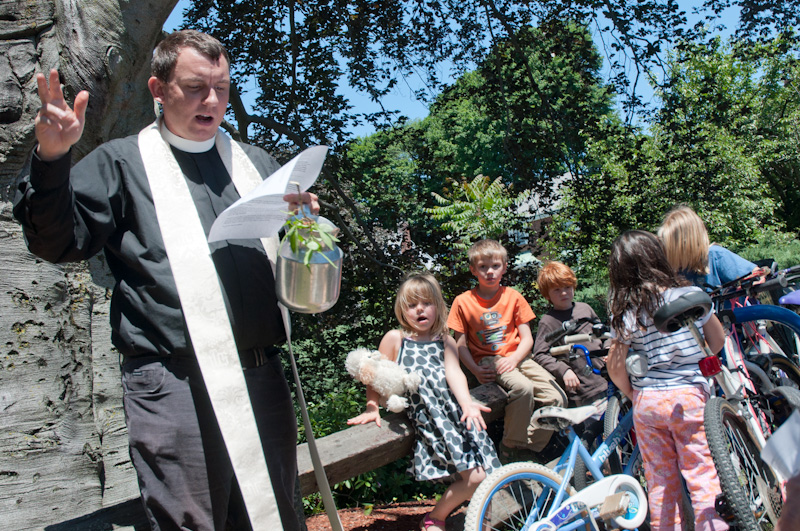
Now if you were to ride by the church this Sunday morning, June 15th, at 11:30 you will see something unusual and special there: a crowd of cyclists gathered around a new bike rack, with the church's reverend, Noah Evans, blessing bicycles, tricycles, helmets and all things cycling related.

We wanted to know what this is this all about, so we asked Rev. Evans a few questions.

Where did the idea of blessing bikes come from?

In the tradition of the Episcopal Church we bless many things, marriages, children, houses, teachers and even backpacks. We bless things not as a way of somehow making them special, but in order to hold up their importance in our lives.

A number of churches have blessed bikes, so it is not an idea that we invented. We decided that this is a good time to do it because we just installed a new bike rack at the church. Many folks in the community are discovering biking as a way to live out their faith commitment to care for creation, and for their own health and wellness.

Blessing bikes is a symbolic act, but installing a new bike rack provides a very practical amenity. Are these ideas connected?

Deeply connected.

At Grace Church we like to look at our church building as a model for the caring of creation that people can apply in their own homes and buildings. Installing the bike rack is a way we can encourage and support biking to church or toGraceWorks.

It also serves as a visible symbol for all to see of how we are trying to live out our faith commitments by living our lives differently. The blessing of bicycles is a way of nurturing, encouraging and supporting people who wish to practice these ideals.

Grace Church has embarked on a number of environmental initiatives, such as the Greening Graceprogram. Is this part of the Episcopal Church's mission or tradition?

The traditions of the Episcopal Church flow from the Church of England. It originally served a very rural, agrarian society, so there has been a long tradition of praying for the earth and for its care, especially as it related to the cycles of planting and harvesting.

More recently there has been a growing understanding that climate change is the largest moral issue of our time and we, as people of faith, have to respond.

This has piqued our passions at Grace Church and over the last five years we have worked hard to address these issues. We have replaced our old heating system with a high efficiency one and installed solar panels. We have also done a lot to reduce our energy usage and increase the proportion of materials we recycle.

We have developed and run the GreenUp CleanUp program to help maintain Medford’s green spaces.  More recently we have put in a vegetable garden to grow food for local food pantries.

Our environmental commitments have touched every part of the life of our community and the bike rack is just the most recent manifestation of our ongoing commitment to caring for creation.

How can riding bicycles help address some the social and environmental challenges facing our community? 

Bicycling, instead of driving, reduces greenhouse gas emissions, which contribute to global warming. It also decreases congestion on local roads.

I have also come to believe that bicycling—and walking—brings people closer and makes them more connected within their communities. Just getting people outside of cars brings them closer to the particularities of a place and the people within it. This can help to draw folks together, build awareness of community and make them feel invested in building a society that comes closer to reflecting the values we profess.

Motorists, bicyclists and pedestrians need to work together to make transportation safe and efficient. Are there lessons from your tradition that can help us do this?

Everyone plays a role in developing a transportation system that is safe and environmentally friendly. It is important for bicyclists and motorists not to see themselves as competitors, but instead as partners working together for safety, community and care of creation.

If you would like to have your bicycle, or any other human-powered vehicle blessed, Grace Church invites you to come. Cyclists of all faiths, ages and abilities are welcome to celebrate and share in their tradition.

Tuesday, May 13, 2014

EPISCOPAL CITY MISSION DIVESTS FROM FOSSIL FUELS

Episcopal City Mission Board Votes to Completely Divest from Fossil Fuels
May 12, 2014 – Boston, MA - Episcopal City Mission (ECM), an agent for social and economic justice with headquarters in Boston, MA, has decided to divest its endowment from fossil fuels. The unanimous vote of the ECM Board of Directors took place at the May 8 meeting after months of research, reflection and deliberation that included diligent analysis of the potential financial impact of divestment on its investments. The Finances Committee and the Board of Directors were satisfied that ECM’s portfolio manager has designed an investment strategy with comparable returns so that their fiduciary responsibilities for the endowment can be exercised without exposure to fossil fuels.

The action of the ECM Board comes in part in response to a Resolution passed by the 2013 Episcopal Diocese of Massachusetts Diocesan Convention on “Environmentally Responsible Investing.” The Diocesan Resolution calls for a freezing of direct investments in the Carbon Tracker top 200 fossil fuel companies; its asks that the Trustees of the Diocese, congregations, and other affiliated institutions research and identify “best in class” fossil fuel companies and that assets of the Diocesan Investment Trust only include “best in class” fossil fuels companies after November 2013, and it calls for the design of “an alternative investment vehicle that is free from fossil fuel production companies.” ECM, an institution affiliated to the Diocese, had already limited its exposure to fossil fuels only to “best in class” companies prior to November 2013. After the November 2013 Diocesan Convention, ECM began to work with its portfolio manager to explore an alternative instrument, free of fossil fuels. On May 8, 2014 ECM adopted it.

After the vote, the Chair of the Board of Episcopal City Mission, The Rev. Noah H. Evans, said: “It is my hope the ECM’s actions here will encourage other Episcopal organizations, including our own Diocese’s Trustees of Donations and other investors, to take a hard look at their portfolios and whether they are in line with their faith commitments, including social justice and caring for creation.”

ECM’s Executive Director, Dr. Ruy O. Costa, quoted the teachings of the apostle Paul in his letter to the Christians in Rome that “creation awaits with eager expectation the revelation of the children of God,” and commented: “I hope that what is manifested in our work and through our investments is a theology of caring: caring for our neighbors, caring for the future, and caring for nature.”

Episcopal City Mission works for social and economic justice with special attention to the needs of the urban poor. ECM mobilizes Episcopal parishes, individuals and resources in partnership with other community organizations for social structural change. ECM supports community organizing, mission-related investments in affordable housing, community economic development, and public policy advocacy.


For more information:
Dr. Ruy O. Costa
Executive Director
(617) 482-4826 x 208
http://www.episcopalcitymission.org/

Episcopal City Mission
138 Tremont Street
Boston, MA 02111
617.482.4826 or toll free 800.696.6079
Fax: 617.338.5546